

News
News
Published on 12/05/2026
FISEVI Connects Science and Society at the 24th Seville Science Fair
Share on:
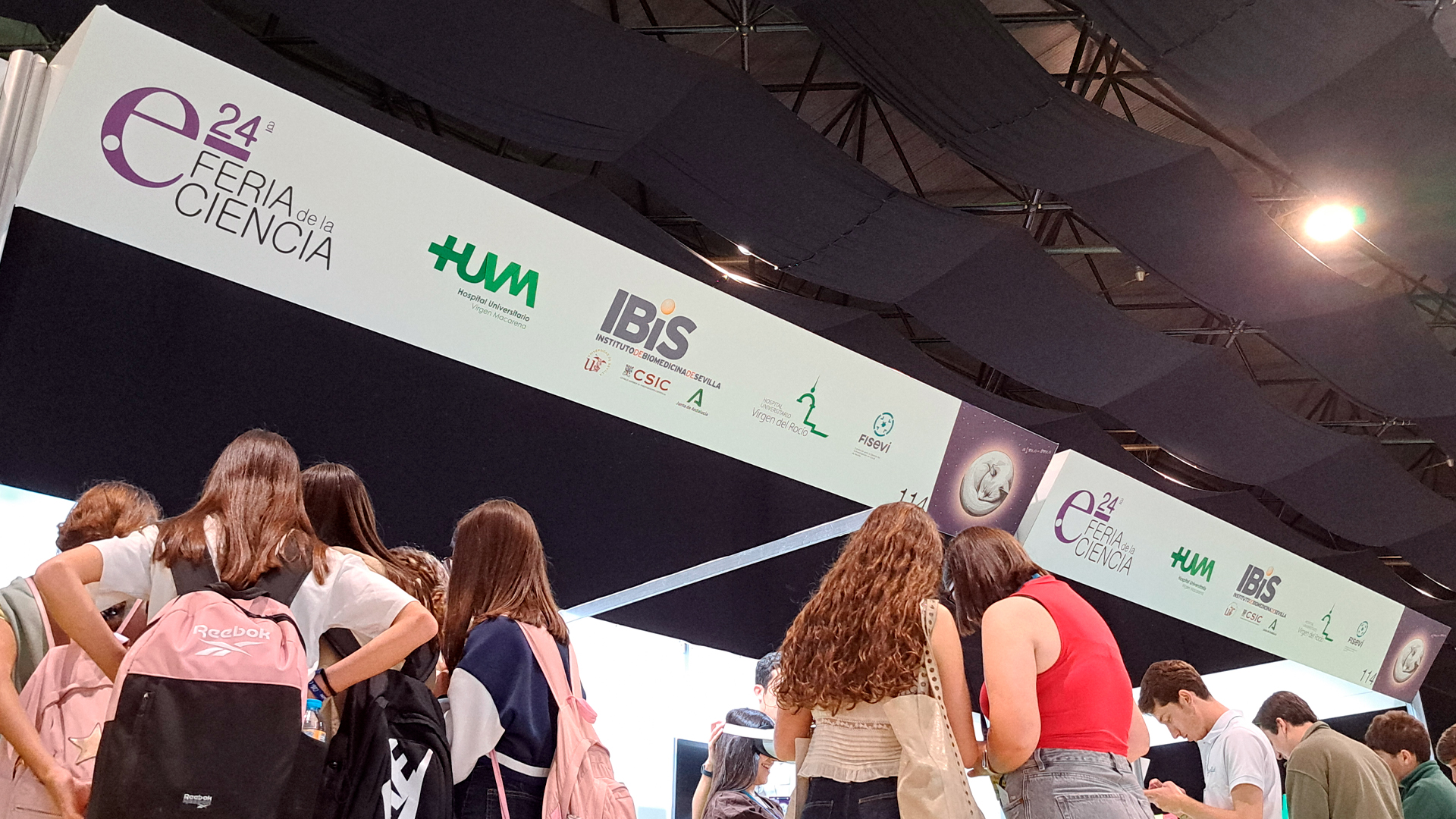
Once again, the 24th edition of the Science Fair, held in Hall 1 of FIBES, brought together numerous activities and talks on 6, 7, and 8 May, offering visitors the opportunity to learn more about the research carried out by the Instituto de Biomedicina de Sevilla (IBiS), the Foundation for the Management of Health Research in Seville (FISEVI), and the Virgen del Rocío and Virgen Macarena University Hospitals.
FROM STAND 114
The opening day on Wednesday 6 May began with engaging activities such as “Pasapalabra: Animals and Science”, led by Cristina Pichardo Guerrero, Ana Mª González Ortega, Alberto Castejón González and Ana Carmen Sánchez Hidalgo. The session explored the use of animal models in biomedical research, encouraging critical thinking and helping to debunk common myths.Another highlight was “A Journey Through Stroke”, presented by Nazaret Nieto, Ángela González Díaz, Carmen del Río, Carmen Ortiz, Silvia Ramírez Díaz, Alejandro Fernández Vega and Marina Romero. Using a brain model, the team visually explained what happens during a stroke, its symptoms, and the importance of rapid intervention.Younger visitors actively took part in “Open Case: Respiratory Failure”, an interactive experience designed by Salomé Castell Calderón, María Melero Cabrero, Clara Sánchez Prieto and Alicia Sánchez Roncero, focused on how the respiratory system works and the harmful effects of smoking and, more recently, vaping.
In the afternoon, “Mind at Play”, delivered by Rosa López Domingo, Pablo Reguera Pozuelo, Maurizio Riga and Amanda Moreno Mellado, explored emotions, perception and optical illusions. Likewise, “Co-creating Pathways to Mental Health Access”, organised by Carmen Torrejón Guirado, Marta Lima Serrano, Clara Corrales Fernández and Claudia Alejandra Corpus Espinosa, encouraged reflection on barriers to accessing mental health services.The day concluded with “HIV, Epigenetics and Shock and Kill”, presented by Claudia del Campo Alcoba, Ana Cristina Reguera Laínez and Mohamed Mhaiham, who explained innovative strategies to combat the virus.
Thursday 7 May continued with educational activities such as “Learning from the Smallest”, developed by Alejandra Huecas, Blanca de Lepe, Claudia Rodríguez, Mafalda Saganha, Manuel Vizcaíno, Patricia Ybot, Marta Ramírez and Elena Soto, which focused on embryonic development and the use of experimental models. In “From Kitchen to Laboratory: Extracting DNA from Fruit”, Sara López Martínez, Joana Vitallé Andrade and Ángel David Quiñones Fayad demonstrated how DNA can be extracted using everyday materials. In addition, “Bacteria Hunters”, designed by Mª Eugenia Pachón Ibáñez, Lucía Ceballos Romero and Mª del Pilar Sánchez Suero, turned participants into scientists tasked with controlling infectious outbreaks and understanding bacterial resistance.
During the afternoon, “Superhero School: What Happens When a Guardian Falls Asleep?”, led by Beatriz de Felipe Carrillo, Sara Montero Crespo, Pilar Blanco Lobo and David Fernando Moreno Fuentes, introduced visitors to the body’s defence mechanisms against disease through playful activities. Meanwhile, “DNA Detectives: What Are Our Cells Hiding?”, presented by Asunción Espinosa Sánchez, Julia Rodrigo Muñoz, Paula Fernández Diánez and Manuel Celis Romero, allowed participants to explore the role of DNA and its importance in understanding biological processes. The “A Journey Through Stroke” activity, organised by the Neurovascular Group, was also repeated at the stand.
On Friday 8 May, the morning session featured “Guardians of the Human Body”, developed by Miriam Yagüe Capilla and Laura Boyero Corral, combining games and learning about the human body, health, and drug development. Another standout activity was “Beyond Muscle: Training the Brain to Prevent Injuries”, delivered by Isabel Escobio Prieto, Elena Piñero Pinto, Paula Barea Alcalá, Miryam Quintano Villar, Carlos Sánchez Beato and Rafael Manuel Navarro Alfaro. Through interactive experiences, the session explored the relationship between the brain, movement, and injury prevention. Similarly, “The Bacteria Challenge: Do You Win or Do They?”, created by María Victoria Gil Navarro, Didiana Jaramillo Ruíz, Irene Sotillo Sánchez and Tania Cebrero Cangueiro, offered an interactive activity where visitors learned about the appropriate use of antibiotics and visualised the number of microorganisms present on their hands, highlighting the importance of hygiene in infection prevention.
In the afternoon, “Mind at Play” returned, alongside the TEMPO Project: Recovering Rhythm After Breast Cancer, developed by Ana Trigueros Murillo, María Jesús Casuso Holgado, Elena Martínez Castellanos, Alberto Marcos Heredia Rizo and Salustiano Gutiérrez Rosa. The project focused on how music influences physical performance and recovery. Through practical activities, participants discovered how music can act as an immediate stimulus to improve physical capacity.
PARTICIPATION IN THE SEVILLE SPACE FORUM STAND PROGRAMME
Beyond the main stand, the organisation also participated in stand no. 60 (Seville Space Forum) with the Cardiovascular Pathophysiology Group and its workshop “Hearts in Orbit”. Developed by Marta de Jesús Gutiérrez Barranco, Celia Cordero Sánchez, Débora Falcón Boyano, Loreto Escacena Izquierdo, Beltzane Domínguez Liste, Carlos Asprón Martín, Clara Molina, Rocío Velasco and Alberto Martín, the workshop used practical and engaging activities to explain how the human body—and particularly the cardiovascular system—adapts to space conditions. Through interactive demonstrations, attendees learned about phenomena such as fluid redistribution in microgravity and its impact on the heart, as well as the physical training astronauts undertake to cope with these conditions.
BRINGING RESEARCH CLOSER TO YOUNG STUDENTS
In addition, the fair’s LOOK INTO SCIENCE and SCIENCE FORUM spaces hosted a series of short outreach talks delivered by Antonio Alba Robles, Isabel Mª García Candón, José Miguel Jiménez, Mª Carmen Torrejón Guirado, Ángel David Quiñones Fayad and Ana Trigueros Murillo. These talks covered topics including adult neurogenesis, the somatosensory system, and the role of research in nursing, helping to present scientific work to younger audiences in an accessible and engaging way.
FISEVI Connects Science and Society at the 24th Seville Science Fair
Once again, the 24th edition of the Science Fair, held in Hall 1 of FIBES, brought together numerous activities and talks on 6, 7, and 8 May, offering visitors the opportunity to learn more about the research carried out by the Instituto de Biomedicina de Sevilla (IBiS), the Foundation for the Management of Health Research in Seville (FISEVI), and the Virgen del Rocío and Virgen Macarena University Hospitals.
FROM STAND 114
The opening day on Wednesday 6 May began with engaging activities such as “Pasapalabra: Animals and Science”, led by Cristina Pichardo Guerrero, Ana Mª González Ortega, Alberto Castejón González and Ana Carmen Sánchez Hidalgo. The session explored the use of animal models in biomedical research, encouraging critical thinking and helping to debunk common myths.Another highlight was “A Journey Through Stroke”, presented by Nazaret Nieto, Ángela González Díaz, Carmen del Río, Carmen Ortiz, Silvia Ramírez Díaz, Alejandro Fernández Vega and Marina Romero. Using a brain model, the team visually explained what happens during a stroke, its symptoms, and the importance of rapid intervention.Younger visitors actively took part in “Open Case: Respiratory Failure”, an interactive experience designed by Salomé Castell Calderón, María Melero Cabrero, Clara Sánchez Prieto and Alicia Sánchez Roncero, focused on how the respiratory system works and the harmful effects of smoking and, more recently, vaping.
In the afternoon, “Mind at Play”, delivered by Rosa López Domingo, Pablo Reguera Pozuelo, Maurizio Riga and Amanda Moreno Mellado, explored emotions, perception and optical illusions. Likewise, “Co-creating Pathways to Mental Health Access”, organised by Carmen Torrejón Guirado, Marta Lima Serrano, Clara Corrales Fernández and Claudia Alejandra Corpus Espinosa, encouraged reflection on barriers to accessing mental health services.The day concluded with “HIV, Epigenetics and Shock and Kill”, presented by Claudia del Campo Alcoba, Ana Cristina Reguera Laínez and Mohamed Mhaiham, who explained innovative strategies to combat the virus.
Thursday 7 May continued with educational activities such as “Learning from the Smallest”, developed by Alejandra Huecas, Blanca de Lepe, Claudia Rodríguez, Mafalda Saganha, Manuel Vizcaíno, Patricia Ybot, Marta Ramírez and Elena Soto, which focused on embryonic development and the use of experimental models. In “From Kitchen to Laboratory: Extracting DNA from Fruit”, Sara López Martínez, Joana Vitallé Andrade and Ángel David Quiñones Fayad demonstrated how DNA can be extracted using everyday materials. In addition, “Bacteria Hunters”, designed by Mª Eugenia Pachón Ibáñez, Lucía Ceballos Romero and Mª del Pilar Sánchez Suero, turned participants into scientists tasked with controlling infectious outbreaks and understanding bacterial resistance.
During the afternoon, “Superhero School: What Happens When a Guardian Falls Asleep?”, led by Beatriz de Felipe Carrillo, Sara Montero Crespo, Pilar Blanco Lobo and David Fernando Moreno Fuentes, introduced visitors to the body’s defence mechanisms against disease through playful activities. Meanwhile, “DNA Detectives: What Are Our Cells Hiding?”, presented by Asunción Espinosa Sánchez, Julia Rodrigo Muñoz, Paula Fernández Diánez and Manuel Celis Romero, allowed participants to explore the role of DNA and its importance in understanding biological processes. The “A Journey Through Stroke” activity, organised by the Neurovascular Group, was also repeated at the stand.
On Friday 8 May, the morning session featured “Guardians of the Human Body”, developed by Miriam Yagüe Capilla and Laura Boyero Corral, combining games and learning about the human body, health, and drug development. Another standout activity was “Beyond Muscle: Training the Brain to Prevent Injuries”, delivered by Isabel Escobio Prieto, Elena Piñero Pinto, Paula Barea Alcalá, Miryam Quintano Villar, Carlos Sánchez Beato and Rafael Manuel Navarro Alfaro. Through interactive experiences, the session explored the relationship between the brain, movement, and injury prevention. Similarly, “The Bacteria Challenge: Do You Win or Do They?”, created by María Victoria Gil Navarro, Didiana Jaramillo Ruíz, Irene Sotillo Sánchez and Tania Cebrero Cangueiro, offered an interactive activity where visitors learned about the appropriate use of antibiotics and visualised the number of microorganisms present on their hands, highlighting the importance of hygiene in infection prevention.
In the afternoon, “Mind at Play” returned, alongside the TEMPO Project: Recovering Rhythm After Breast Cancer, developed by Ana Trigueros Murillo, María Jesús Casuso Holgado, Elena Martínez Castellanos, Alberto Marcos Heredia Rizo and Salustiano Gutiérrez Rosa. The project focused on how music influences physical performance and recovery. Through practical activities, participants discovered how music can act as an immediate stimulus to improve physical capacity.
PARTICIPATION IN THE SEVILLE SPACE FORUM STAND PROGRAMME
Beyond the main stand, the organisation also participated in stand no. 60 (Seville Space Forum) with the Cardiovascular Pathophysiology Group and its workshop “Hearts in Orbit”. Developed by Marta de Jesús Gutiérrez Barranco, Celia Cordero Sánchez, Débora Falcón Boyano, Loreto Escacena Izquierdo, Beltzane Domínguez Liste, Carlos Asprón Martín, Clara Molina, Rocío Velasco and Alberto Martín, the workshop used practical and engaging activities to explain how the human body—and particularly the cardiovascular system—adapts to space conditions. Through interactive demonstrations, attendees learned about phenomena such as fluid redistribution in microgravity and its impact on the heart, as well as the physical training astronauts undertake to cope with these conditions.
BRINGING RESEARCH CLOSER TO YOUNG STUDENTS
In addition, the fair’s LOOK INTO SCIENCE and SCIENCE FORUM spaces hosted a series of short outreach talks delivered by Antonio Alba Robles, Isabel Mª García Candón, José Miguel Jiménez, Mª Carmen Torrejón Guirado, Ángel David Quiñones Fayad and Ana Trigueros Murillo. These talks covered topics including adult neurogenesis, the somatosensory system, and the role of research in nursing, helping to present scientific work to younger audiences in an accessible and engaging way.
Publicado el: 12/05/2026
Compartir en:
