

News
News
Published on 24/06/2026
European COST Action Delve-into-Pneumocystis Training School held at IBiS
Share on:
- The training event explored advanced evidence synthesis strategies and the potential of artificial intelligence to transform research
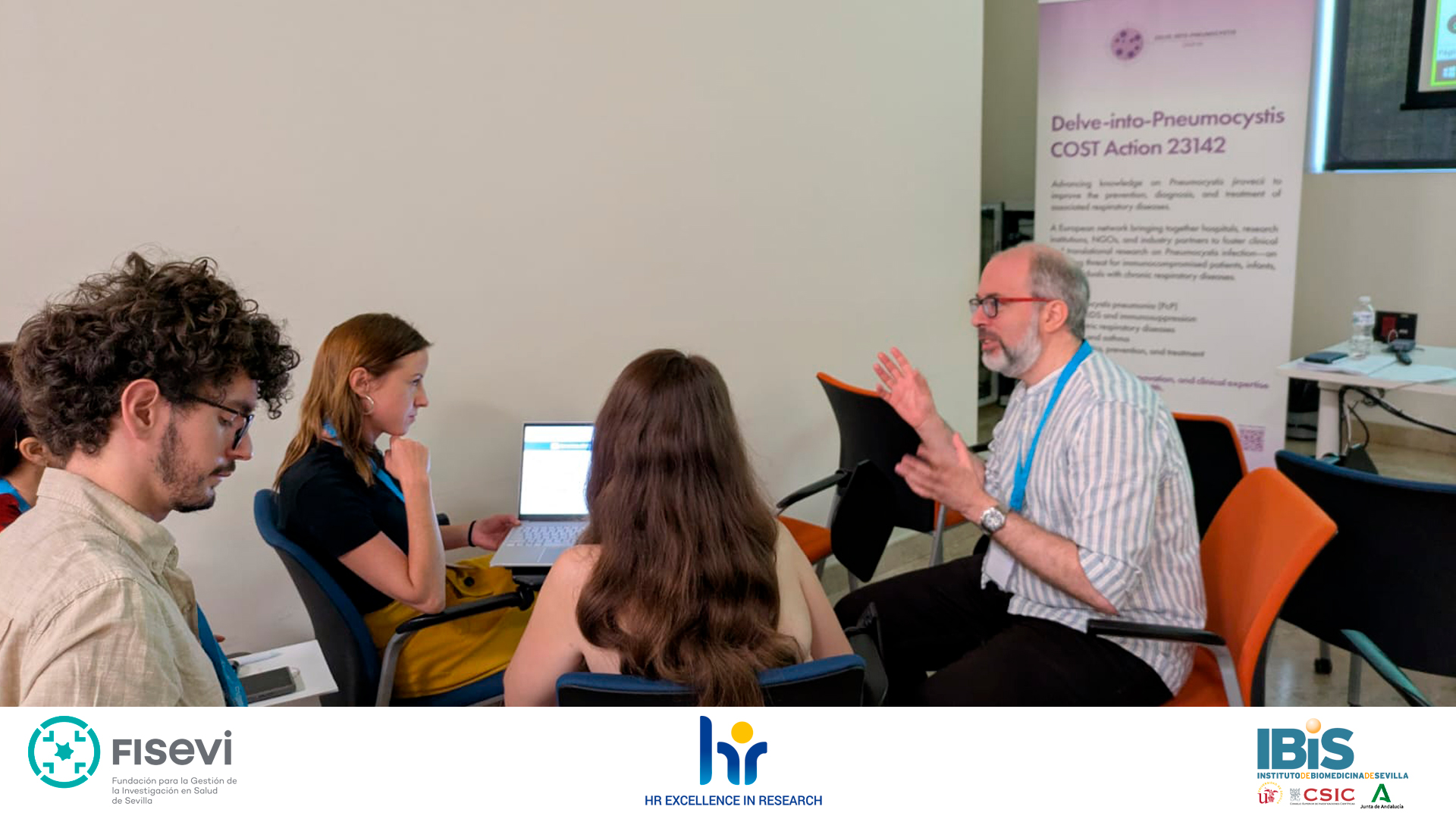
The researcher Antonio Vallejo Vaz with some of the attendees at his lecture. | IBiS-FISEVI Communication and Outreach Unit
The Institute of Biomedicine of Seville (IBiS) hosted the Training School entitled “Evidence Synthesis, Meta-analysis, and Emerging AI-Supported Methodologies for Pneumocystis Research” on 22 and 23 June. The training initiative was organised within the framework of the European COST Action Delve-into-Pneumocystis (CA23142).
Held in a hybrid format and coordinated by Enrique J. Calderón Sandubete, lead researcher of the IBiS Clinical Epidemiology and Vascular Risk Group, the event brought together researchers interested in strengthening their expertise and learning about new AI-supported methodologies applied to the study of the pathogen Pneumocystis.
The training programme featured presentations by researchers Antonio Vallejo Vaz and Juan Mora Delgado, who delivered sessions focused on conducting systematic reviews, scoping reviews, and meta-analyses. During the first day, key concepts related to formulating research questions, the PRISMA (Preferred Reporting Items for Systematic Reviews and Meta-Analyses) methodological framework, and study selection were addressed, alongside practical examples applied to Pneumocystis research.
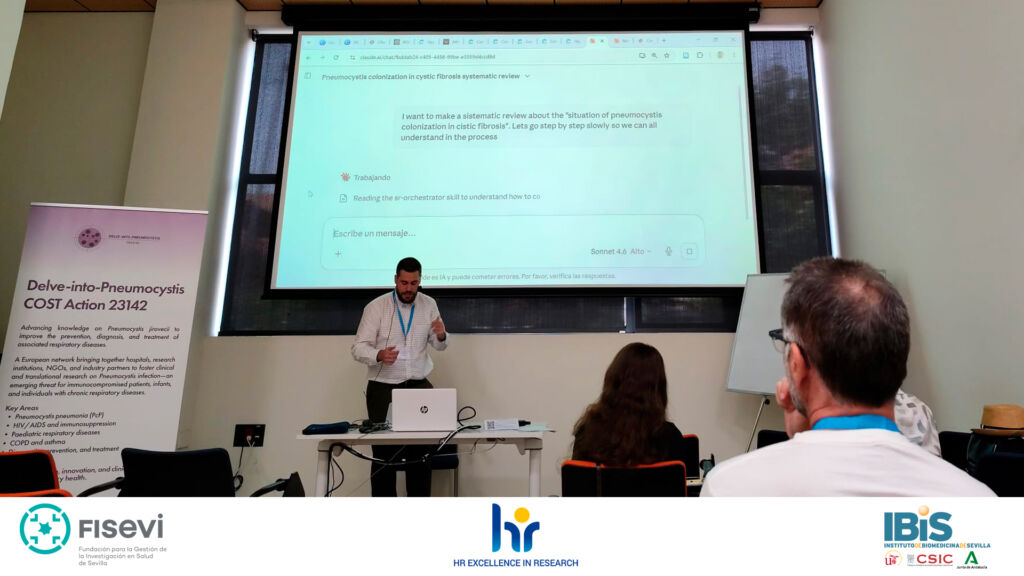
The researcher Juan Delgado Mora during his presentation. | IBiS-FISEVI Communication and Outreach Unit
During the second day, participants examined the opportunities and limitations of AI-based tools for optimising the identification, evaluation, and integration of scientific evidence, as well as the methodological challenges associated with their use. The course also included dedicated sessions on the fundamentals of meta-analysis, the interpretation of effect measures, the assessment of heterogeneity, and the analysis of real-world cases in Pneumocystis research.
All activities within the programme were designed to encourage the exchange of experiences among the different centres and countries involved in the project, fostering the development of new opportunities for scientific collaboration.
The COST Action CA23142 Delve-into-Pneumocystis initiative is funded through the European Union’s COST (European Cooperation in Science and Technology) programme and aims to develop effective responses to Pneumocystis infection through better integration of clinical knowledge and research on this disease.
European COST Action Delve-into-Pneumocystis Training School held at IBiS
- The training event explored advanced evidence synthesis strategies and the potential of artificial intelligence to transform research
The researcher Antonio Vallejo Vaz with some of the attendees at his lecture. | IBiS-FISEVI Communication and Outreach Unit
The Institute of Biomedicine of Seville (IBiS) hosted the Training School entitled “Evidence Synthesis, Meta-analysis, and Emerging AI-Supported Methodologies for Pneumocystis Research” on 22 and 23 June. The training initiative was organised within the framework of the European COST Action Delve-into-Pneumocystis (CA23142).
Held in a hybrid format and coordinated by Enrique J. Calderón Sandubete, lead researcher of the IBiS Clinical Epidemiology and Vascular Risk Group, the event brought together researchers interested in strengthening their expertise and learning about new AI-supported methodologies applied to the study of the pathogen Pneumocystis.
The training programme featured presentations by researchers Antonio Vallejo Vaz and Juan Mora Delgado, who delivered sessions focused on conducting systematic reviews, scoping reviews, and meta-analyses. During the first day, key concepts related to formulating research questions, the PRISMA (Preferred Reporting Items for Systematic Reviews and Meta-Analyses) methodological framework, and study selection were addressed, alongside practical examples applied to Pneumocystis research.
The researcher Juan Delgado Mora during his presentation. | IBiS-FISEVI Communication and Outreach Unit
During the second day, participants examined the opportunities and limitations of AI-based tools for optimising the identification, evaluation, and integration of scientific evidence, as well as the methodological challenges associated with their use. The course also included dedicated sessions on the fundamentals of meta-analysis, the interpretation of effect measures, the assessment of heterogeneity, and the analysis of real-world cases in Pneumocystis research.
All activities within the programme were designed to encourage the exchange of experiences among the different centres and countries involved in the project, fostering the development of new opportunities for scientific collaboration.
The COST Action CA23142 Delve-into-Pneumocystis initiative is funded through the European Union’s COST (European Cooperation in Science and Technology) programme and aims to develop effective responses to Pneumocystis infection through better integration of clinical knowledge and research on this disease.
Publicado el: 24/06/2026
Compartir en:
